Nginx: The Web Server Powering the Modern Internet

When you open a website and it loads almost instantly, there’s a good chance Nginx is behind it. Today, Nginx powers more than one-third of all active websites, including giants like Netflix, Dropbox, and WordPress. But what makes Nginx so fast, reliable, and scalable compared to traditional web servers?
This blog dives deep into how Nginx works internally, why it handles millions of requests efficiently, how it differs from older process/thread-based servers, and where it shines in real-world use cases.
1. A Quick Origin Story
Nginx (pronounced “Engine-X”) was created by Igor Sysoev in 2004 to solve the C10k problem, the challenge of handling 10,000+ simultaneous client connections on a single server.
At a time when traditional web servers struggled with concurrency, Nginx’s event-driven, asynchronous architecture became a game-changer. Instead of spawning a process or thread for every connection, Nginx uses a small number of worker processes that handle thousands of requests concurrently.
2. How Nginx Works Internally
At its core, Nginx is built on the principle of event-driven non-blocking I/O. Let’s break this down:
2.1 Master–Worker Model
Master Process: Handles configuration, starts/stops workers, and monitors them.
Worker Processes: Do the heavy lifting, handling client connections and serving requests. Each worker is single-threaded but can manage thousands of connections.
This design makes Nginx robust, if one worker fails, the others keep running.
2.2 Event Loop & Asynchronous I/O
Instead of blocking on each request, workers use an event loop. When a new request arrives:
Worker gets notified via OS-level mechanisms like
epoll(Linux) orkqueue(BSD).The worker registers events (read, write, timeout) and continues serving other requests.
When the event is ready, it processes it and moves on.
This means one worker can juggle thousands of sockets without waiting idly for data.
3. Nginx vs Traditional Web Servers
Before Nginx, the most common web server was Apache HTTP Server. Let’s compare their models:
| Feature | Apache (Traditional) | Nginx |
| Architecture | Process/Thread per connection | Event-driven, async |
| Concurrency Handling | Spawns OS processes/threads → high memory usage | Few workers handle thousands of connections |
| Resource Usage | Heavy, scales poorly | Lightweight, scales easily |
| Performance | Great for small/medium workloads | Excellent for high concurrency |
| Flexibility | Rich module ecosystem, dynamic loading | High-performance focus, modules compiled in |
In short:
Apache = good for dynamic content and complex configurations.
Nginx = blazing fast for static content, reverse proxying, load balancing, and high concurrency.
4. How Nginx Handles Millions of Requests
Nginx’s efficiency comes from:
Non-blocking I/O → Never stuck waiting for one request.
Event loop → Reuses the same worker for thousands of clients.
Low memory footprint → A few MBs per worker, even under heavy load.
Scalability → Easy to add more worker processes or servers.
This is why companies like Netflix stream terabytes of data through Nginx without bottlenecks.
5. Key Use Cases of Nginx
Nginx is more than a web server. It’s a versatile tool for modern web infrastructure:
Static File Server
Serve images, CSS, JS, videos directly from disk with minimal overhead.Reverse Proxy
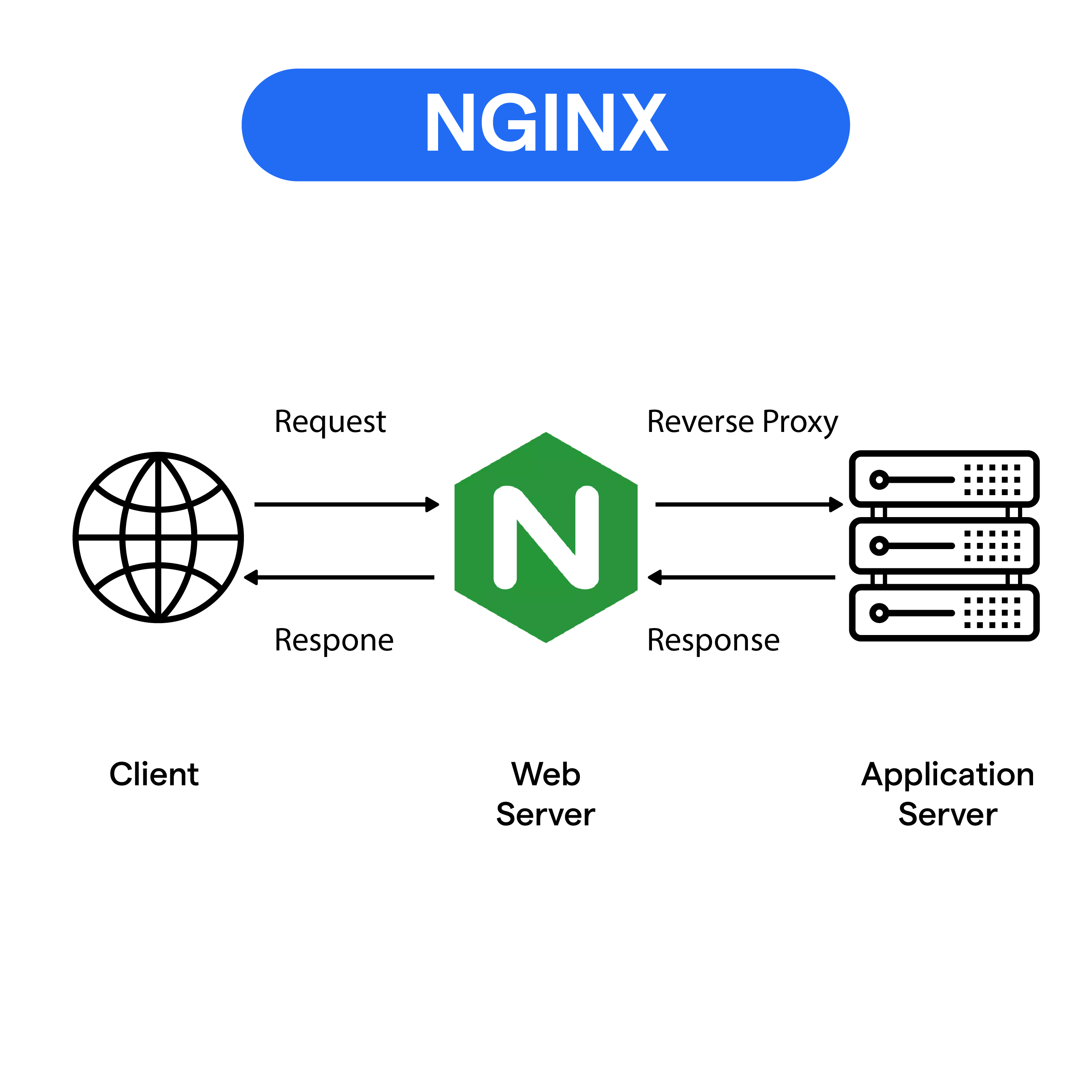
Route client requests to backend servers (Node.js, Python, Java, etc.) while keeping backends hidden.Load Balancer
Distribute traffic across multiple servers with strategies like round-robin, least connections, or IP hash.SSL/TLS Termination
Offload expensive encryption/decryption tasks from backends.API Gateway
Handle authentication, caching, and routing for microservices.Content Caching
Cache static/dynamic responses to reduce backend load.
6. Process vs Thread-Based Models: Why Nginx Wins
Let’s visualize:
Process-based (Apache Prefork)
Each request = a new process. High memory, context switching, CPU overhead.Thread-based (Apache Worker, Java Servers)
Each request = a thread. Better than processes, but still limited by thread count and memory.Event-driven (Nginx)
Each worker handles events instead of dedicating a process/thread per request. Minimal memory, no blocking.
This is why Nginx remains lightweight, scalable, and reliable under extreme traffic.
7. Why Nginx is Different — A Modern Web Philosophy
Nginx isn’t just fast — it’s designed for the cloud-native era:
Optimized for static + dynamic workloads.
Plays well with Docker, Kubernetes, and microservices.
Acts as a reverse proxy for API-driven apps.
Can be integrated with observability tools for metrics and logs.
It’s more than a web server — it’s an essential traffic director for modern applications.
8. Final Thoughts
Nginx’s brilliance lies in its simplicity and efficiency. By adopting an event-driven architecture instead of clinging to traditional process/thread models, it solved the concurrency problem that plagued web servers for years.
Today, whether you’re building a personal blog or running a global streaming service, Nginx can handle the job with elegance.
In a world where milliseconds matter, Nginx remains the engine that drives the modern web.


